Owen Taylor
The Big SleepOwen Taylor, a chauffeur employed by the Sternwood family, is both the killer of Arthur Geiger and the dead man found in a car at Lido Fish Pier. His affection for Carmen Sternwood leads him to intervene when Geiger photographs her, but the shooting and Taylor’s subsequent death become entangled with stolen evidence, concealed information, and a public account that obscures what happened. The discrepancy between the official story and Marlowe’s reconstruction makes Taylor a central figure in the book’s pattern of private violence and public misrepresentation.
Identity and Background
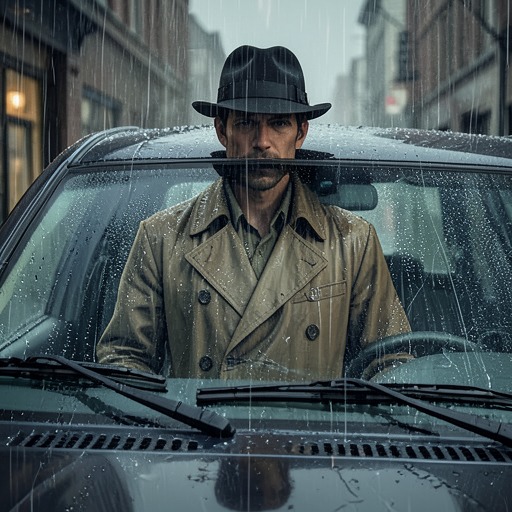
Taylor is described as a slim, dark-haired young chauffeur who had been good-looking not long before his death. He works for the Sternwood family and is associated with the family’s maroon Packard convertible, which Marlowe sees being dusted at the family estate. His position places him close to the household while leaving him outside the family’s wealth and authority.
His history with Carmen predates the Geiger affair. According to Bernie Ohls, Taylor had previously taken her to Yuma; Carmen’s sister, Vivian Regan, brought them back, and Taylor was briefly held on a Mann Act charge. Vivian later intervened with the district attorney, saying Taylor had intended to marry Carmen, while Carmen herself had wanted a party rather than marriage. Despite learning that Taylor had a prior conviction for attempted robbery in Indiana, the Sternwoods kept him employed. The episode establishes that his attachment to Carmen was known within the family and that the household’s treatment of him was not governed simply by his record.
The Geiger Shooting
Marlowe follows Geiger through a rain-soaked evening to a secluded house on Laverne Terrace. He sees Carmen’s Packard arrive and identifies it by its registration, then waits nearby. At 7:20, a flash comes from the house, followed by a scream and, moments later, three shots. Marlowe hears someone run down the back steps and drive away, but he does not see the person. When he later returns, Geiger’s body has been removed, leaving a second rug at the spot where it had lain.
Taylor’s role is explained afterward rather than witnessed. Marlowe’s account is that Taylor went to Geiger’s house because he was in love with Carmen and objected to Geiger’s treatment of her. Entering by the back way with a jimmy and a gun, Taylor surprised Geiger taking a nude photograph of Carmen. Taylor shot him and fled with the photographic negative. The explanation connects the shots Marlowe heard to the earlier disappearance of Geiger’s body and to the struggle over the photographs.
Taylor’s actions do not end with the shooting. Joe Brody tells Marlowe that he pursued the fleeing chauffeur, caught up with him after Taylor’s car skidded, and knocked him unconscious. Brody took the photographic plateholder, but Taylor later regained consciousness and escaped. Brody’s possession of the photographs thus came not from Geiger but from his interception of Taylor after the killing.
Death and the Official Account
Taylor’s car is recovered from the water off Lido Fish Pier, with his body still inside. The scene is not treated as a straightforward accident: the car had been directed toward the pier, its hand throttle pulled down, and Taylor had been struck before the plunge. The physical evidence makes his death part of the same chain of concealed violence as Geiger’s murder, although the available account does not identify the person responsible for Taylor’s death.
The public version suppresses the connection between the two cases. The newspapers describe Taylor as the chauffeur of a wealthy family and report his death as a suicide, while assigning Captain Cronjager credit for solving the Geiger and Brody killings. Their account says Geiger was killed by Brody and Brody by Carol Lundgren, and omits Taylor’s connection to Geiger’s house. It also leaves the Sternwoods and Marlowe out of the story. The distorted chronology and substituted motives turn several linked events into a neat, misleading police success.
Relationships and Consequences
Taylor’s defining relationship is with Carmen. Marlowe identifies his love for her as the reason he went to confront Geiger, and his intervention interrupts Geiger’s exploitation of her image. Yet the protection is limited and costly: Taylor kills Geiger, becomes vulnerable to Brody’s pursuit, and is later found dead. His attachment makes him an actor in the case, but it does not give him control over the machinery of blackmail or the story told about the crimes.
Taylor’s employment also ties him to the Sternwood household’s unequal world. The family knows of his earlier flight with Carmen and of his criminal record, yet retains him as chauffeur. Later, when Marlowe explains the broader scheme to Vivian, he again describes Taylor as a man in love with Carmen who killed Geiger for that reason. Taylor’s role is therefore recovered through the detective’s reconstruction, not through an official finding. The newspapers’ account and Marlowe’s account stand in direct contrast: one erases Taylor’s involvement in Geiger’s death, while the other restores it without resolving who killed Taylor.
Narrative Significance
Taylor’s story demonstrates how a single act can be recast as it passes through competing accounts. The shooting begins as an unseen event Marlowe approaches too late; the body then disappears, the negative changes hands, and Taylor himself becomes the dead man in a car reported as a suicide. Each concealment separates a piece of the truth from the others, making the case depend on reconstruction rather than a reliable public record.
His death also sharpens the novel’s recurring distinction between a person’s fate and the narrative imposed on it. In the newspaper version, Taylor is a despondent chauffeur whose death helps close a case. In Marlowe’s explanation, he is a lover who intervened against Geiger and was drawn into a larger struggle. Neither account supplies a complete resolution of his death, but their contrast exposes how official certainty can coexist with concealed facts.